Paragliding Health Requirements: Age, Weight and Fitness
Prime Turist local team · Updated: October 2026 · 12 min read
The health requirements for paragliding are there to keep every flight safe. If you want to learn to fly solo, flight schools in and around Fethiye will ask you to show that you're physically and mentally fit, usually with a doctor's report. For a tandem flight with Prime Turist you don't need any experience and there's no age limit; up to 100 kg you fly as standard, from 100 to 130 kg a heavy-passenger pilot is arranged for an extra fee, and you just need to tell us about any health condition before you book.
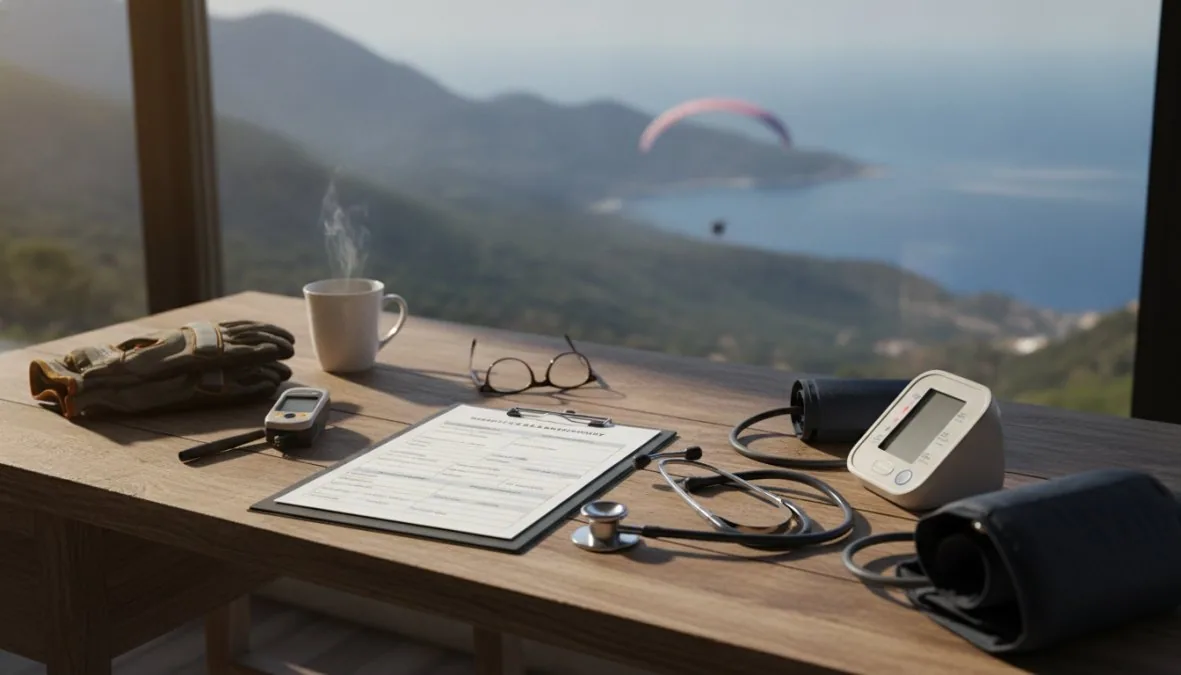
Paragliding Health Requirements: The Basics
Being fit to fly isn't only about being the right age and weight. Heart health, neurological health, the condition of your spine and your mental health all matter too. If you're training as a pilot in the Muğla region, you'll usually need a doctor's report confirming this.
Medical Fitness Assessment
The fitness-to-fly assessment should be done at a full-service hospital or an authorised health centre, where a doctor looks at your physical and psychological condition in detail.
Things usually checked during the assessment: blood pressure and heart rhythm, eyesight, hearing, balance and coordination, neurological reflexes, lung capacity, blood sugar and your general physical condition.
After going through these, the doctor decides whether you're ‘fit to fly’ or ‘not fit’. If you're taking a pilot course in Fethiye, you hand this report in to the flight school.
Physical Fitness and Stamina
Paragliding may look like a passive sport, but learning to fly takes real stamina. As a student pilot you may have to carry a heavy pack with your wing and harness, and run down a mountain slope at take-off.
Physical fitness covers cardiovascular endurance (being able to exercise at moderate intensity for at least 20–30 minutes), leg strength, shoulder and arm strength, flexibility and balance.
If you haven't done any sport in the last six months, it's a good idea to spend at least 4–6 weeks getting fitter before a paragliding course.
Tip: Talk to your family doctor before you start. If you've been fairly inactive, build up your fitness with light running, swimming or cycling for 4–6 weeks before the course.
Paragliding Medical Report: Why You Need One
The medical report is the most important document for paragliding training. It isn't just a form the school needs for its paperwork; it's an official document designed to keep flying safe.
In Turkey, pilot training generally requires written medical clearance before the course starts, and international air sports practice is similar. Once signed by a doctor, the report also protects both the pilot and the instructor.
Where to Get a Medical Report
In the Muğla and Fethiye area, you can usually get the report from one of these types of institution:
Full-service hospitals: a thorough assessment, with cardiology, neurology and physiotherapy specialists on hand.
Family health centres: a basic assessment, though they may refer you to a hospital for anything more complex.
Private health centres: clinics with a sports medicine specialist can prepare a suitable report for paragliding.
When you go for the report, check whether the clinic has experience with ‘air sports’ or ‘paragliding’ reports.
What the Report Covers
A medical check for paragliding typically covers points like these:
Check · Why it matters · What the doctor looks for
Blood pressure · Heart health · Normal or well-controlled readings
Heart rhythm · Screening for arrhythmia · A regular resting heart rhythm
Blood sugar · Screening for diabetes · Stable, well-controlled levels
Haemoglobin · Oxygen-carrying capacity · No significant anaemia
Eyesight · Safety · Good vision, with glasses or lenses if needed
Hearing · Communication with the instructor · Able to follow spoken and radio instructions
Neurological exam · Balance and coordination · Normal reflexes and balance
Lung function · Oxygen intake · No significant breathing restriction
Ask the doctor to state clearly in the report that you are ‘fit to fly a paraglider’.
Note: When you ask for the report, explain to the doctor what paragliding involves, such as height, speed and exposure to wind. Some doctors issue a standard health report without considering the risks specific to the sport.
Paragliding Age Limits and Age-Related Requirements
Age requirements for pilot training are set by Turkey's air sports rules and by each school, and younger and older pilots are assessed a little differently.
Requirements for Young Pilots
The minimum age for pilot training depends on the school and the federation's current rules; it's usually somewhere between 16 and 18. Under-18s generally need written consent from a parent or guardian.
Extra requirements for young pilots usually include written consent from a parent or guardian, a doctor's approval, a beginner pilot certificate and first flights under an instructor's supervision.
Older Pilots and Physical Assessment
There's generally no official upper age limit for paragliding, but people over 60 can expect a more thorough medical assessment.
For pilots aged 60 and over, the doctor may ask for extra tests such as a stress test, an electrocardiogram (ECG), a bone density check, eyesight and hearing tests, and balance and coordination tests.
In short: what matters is your fitness and health, not your age. A fit 70-year-old may well fly more safely than an inactive 35-year-old. And on Prime Turist's tandem flight from Babadağ there's no age limit at all.
Paragliding Weight Limits and Height
Weight and height matter for matching the wing to the pilot and for flight safety. Every paraglider is certified for a specific weight range.
Weight Range and Choosing the Right Wing
Solo wings come in different sizes, each certified for a set take-off weight (pilot plus equipment). If you fall outside the range of a standard size, you need a wing made for your weight.
On Prime Turist's tandem flight the limits are simple: up to 100 kg you fly as standard; between 100 and 130 kg a heavy-passenger pilot is arranged for an extra fee; 130 kg is the upper limit.
Flight schools in Fethiye choose the wing according to the pilot's weight. If you're outside the standard range, contact the school in advance. For a tandem flight, choose the right passenger option (up to 100 kg or 100–130 kg) when you book.
Height and Equipment
Height matters less than weight, but it does affect how the harness and instruments fit. Very short or very tall pilots may need a special harness.
Height and weight together (BMI) are used in the general health assessment. A BMI of 18.5–29.9 is considered normal; with a BMI of 30 or more, the doctor may ask for extra heart checks.
Health Conditions That Can Stop You Flying
Some health conditions rule out paragliding, or need a specialist's clearance first, because they can become life-threatening in the air.
Heart and Blood Pressure Conditions
Heart and blood pressure problems are the most serious obstacles to paragliding. Height, the effort of take-off and the adrenaline rush all put extra strain on the heart.
Heart conditions that usually rule out flying, or need a cardiologist's clearance: active heart disease or a previous heart attack, uncontrolled high blood pressure, heart arrhythmia, a pacemaker or stent, heart failure and heart valve disease.
If your high blood pressure is under control with medication, flying may be possible, but you'll need your doctor's approval and possibly extra tests.
Epilepsy and Neurological Conditions
Epilepsy and other neurological conditions carry serious risks in paragliding: a seizure in the air can have consequences no one can control.
Neurological conditions that usually rule out flying: uncontrolled epilepsy (recent seizures), frequent dizziness or fainting, severe migraine, a history of losing consciousness, recent brain surgery and advanced Parkinson's disease.
Well-controlled epilepsy may allow flying in some cases, but it must be assessed by a neurologist.
Spinal Problems and Balance Disorders
Spine and balance problems can lead to a loss of control while paragliding. Take-off, flight and landing all put significant load on the spine.
Spinal conditions that usually rule out flying: severe scoliosis, recent spinal surgery, a history of spinal fracture, a symptomatic herniated disc, and spinal tuberculosis or infection.
Balance disorders (vertigo, Ménière's disease, inner ear infections, loss of proprioception) can affect your balance in the air and increase the risk of a fall on landing.
Special Clearance for Chronic Conditions
Pilots with diabetes, asthma and other chronic conditions can often fly after a specialist assessment. It depends on how well the condition is controlled.
Paragliding with diabetes: your blood sugar should be stable before the flight, at a level agreed with your doctor; if you take insulin or other medication, you need your doctor's approval; the risk of low blood sugar during the flight has to be watched.
Paragliding with asthma: flying is possible if mild asthma is under control; severe asthma or frequent attacks can rule it out; keep your inhaler with you.
For chronic conditions, a flight school will usually ask for written approval from a specialist.
Note: If you have a chronic condition, tell the flight school in advance; knowing about it helps them act quickly in an emergency. If you're flying tandem with Prime Turist, tell us about any health problem before you book.
Psychological and Mental Preparation
Paragliding takes mental as well as physical preparation. Fear of heights, anxiety and mental health problems can all affect how you fly.
Fear of Heights and Managing Anxiety
Fear of heights (acrophobia) is common, even among paragliding pilots, but it can be managed with training and experience.
Ways to cope with a fear of heights: gradual exposure, deep breathing techniques, concentration exercises, talking openly with your instructor and positive visualisation.
If you're nervous, tell your instructor or tandem pilot before take-off; talking it through calmly beforehand makes a real difference.
Mental Health and Medication
If you have depression, an anxiety disorder or another mental health condition, mention it openly. Some psychiatric medications can affect how you fly.
Points to discuss with your doctor: SSRIs (selective serotonin reuptake inhibitors) are often compatible with flying; benzodiazepines can be dangerous because of their sedative effect; antipsychotics at high doses may affect flight safety; ADHD medication can raise your heart rate.
If you're being treated for a mental health condition, a flight school will usually ask for written approval from your psychiatrist or mental health specialist.
Paragliding for People with Disabilities
Paragliding can also be made accessible to people with disabilities: with adapted programmes, people with physical disabilities can take part in the sport too.
Adapted Programmes
For people with disabilities, paragliding usually takes the form of a tandem flight (pilot plus passenger), with an experienced pilot in control throughout.
Examples of adaptations: special take-off and landing procedures for wheelchair users; voice-based instructions for blind and partially sighted people; visual signals for deaf and hard-of-hearing people; and special harnesses and equipment for people with limited mobility.
Special Equipment and Safety Measures
The equipment used is an adapted version of standard gear, and safety comes first with every adaptation.
Special equipment can include adaptive harnesses, extra safety straps, voice communication systems and visual signalling devices.
People with disabilities go through a thorough medical and physiotherapy assessment before training. If you have a disability and would like to fly tandem with Prime Turist, please tell us before you book.
Documents and Preparation Before Training
Before paragliding training begins, you need to get certain documents ready and hand them in to the flight school.
Document Checklist for a Beginner Pilot Course
Documents usually needed for a beginner paragliding pilot course:
Document · Required? · Notes
Medical report · Yes · From a full-service hospital; ask the school how recent it must be
Copy of ID · Yes · Turkish ID card or passport
Training form · Yes · Provided by the flight school
Consent form · Yes · Liability waiver
Insurance document · Yes · Usually arranged by the flight school
Parental consent · Yes (under 18) · For minors
Additional medical reports · If applicable · If you have a chronic condition
Ask the school when the documents are due; it's best to send them a few days before the course starts.
Document Checks and the Pilot Licence
Once you've handed in your medical report and other documents, the school checks them and takes care of the registration and licence process with the national air sports authority.
Flight schools in Muğla and Fethiye are used to this process. Ask in advance how long it takes so you can plan when to start training.
Tip: Get your documents ready early. When you ask for the medical report, say that you need it specifically for paragliding.
Understanding the health requirements is the first step to enjoying this exciting sport safely. Fethiye's great flying weather and scenery are even better with a healthy body and a prepared mind. If you'd rather fly without training, Prime Turist offers tandem flights from Babadağ with an experienced pilot: no experience is needed, there's no age limit, and you can choose a female pilot if you prefer. Just tell us about any health condition before you book.
Frequently asked questions
Where should I get a medical report for paragliding? You can get one from a sports medicine doctor at a full-service hospital, from your family doctor or from an emergency medicine specialist. It should be an official document that assesses your fitness to fly and meets the criteria of Turkey's air sports authority. You need it for pilot training; for a tandem flight with Prime Turist, just tell us about any health condition before you book.
What is the age limit for paragliding, and is there an upper limit? For solo pilot training the minimum age is usually 18, although 16- and 17-year-olds can often train with parental consent and a specific medical assessment. There's no upper age limit, but older pilots may need more thorough heart and fitness tests. Prime Turist's tandem flight over Ölüdeniz has no age limit.
What is the weight limit for paragliding, and why does it matter? For solo flying, the right weight depends on the size of the wing, so ask your school. On Prime Turist's tandem flight you fly as standard up to 100 kg; for passengers between 100 and 130 kg a heavy-passenger pilot is arranged for an extra fee, and 130 kg is the upper limit. Weight affects how the wing climbs and handles, and height is taken into account too, because the right equipment for your build is the basis of a safe flight.
Which health conditions rule out paragliding? Heart disease, high blood pressure, epilepsy, serious spinal problems, balance disorders, and uncontrolled diabetes or asthma can all stop you flying. Substance dependence, psychiatric medication and pregnancy also need to be assessed. Every case is assessed individually, and there are special clearance procedures for chronic conditions. Tell us about conditions such as pregnancy, heart problems or recent surgery when you book.